
Is Artificial Intelligence As Noticeable as it Seems?
by Buller Claiborne
Ballerinas growing four legs, clouds talking, and turtles flying in the sky. If you’ve been online for even a small amount of time then you’ve seen the promotions, advertisements, and content made by AI. Maybe you’ve scrolled past it, or maybe you laughed at them, I mean, it’s easy for us to tell the difference between reality and Artificial Intelligence, right? Who would believe a dolphin spitting money out of its mouth is real? Who would believe a deepfake video used in court as evidence to convict a person of a falsely accused crime was real? Truthfully, Artificial Intelligence is becoming harder and harder to identify online and in real life, and with little to no restrictions on the growth of AI, we are facing a crisis on the spread of fake news and distrust in real information.
According to recent studies at Stanford, accuracy in detection of AI content has decreased dramatically over time due to the fast growing pace of AI. As shown in the graph below, the average percentage of images correctly identified by humans is less than 50%, showing how the line between reality and fake news is slowly starting to dissolve. Accessibility to AI resources has also been increasing, with major apps like Chat-GPT, Sora AI, and more. On these sites you are able to generate any image as long as it passes an AI checker. For example, to get around Chat-GPT images not being able to generate blood, some users will substitute the word with ‘ketchup,’ allowing for the user to freely create images that don’t have any restrictions. Anyone is able to make pictures that can be used for evil, and with no direct laws on the usage of AI, it can lead to serious repercussions for the victims.
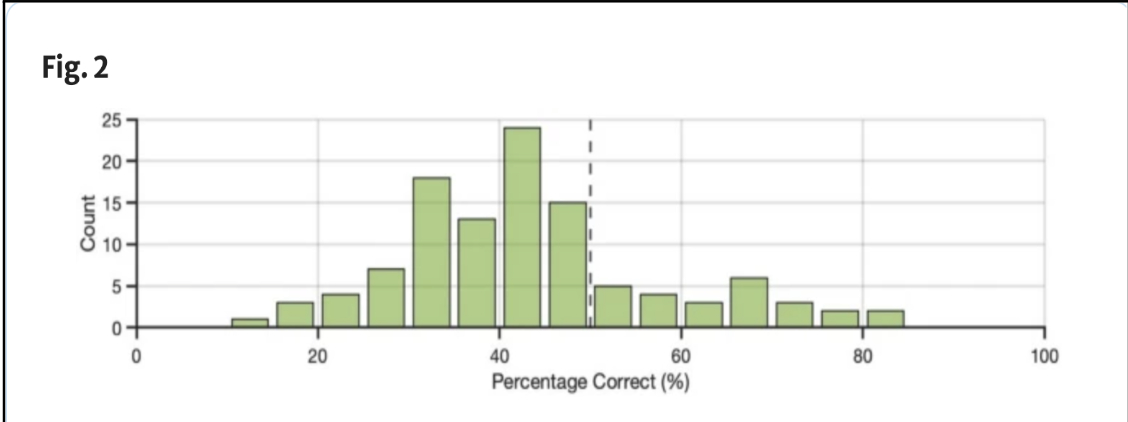
Avg. Percentage of Images Correctly Identified by Humans
AI not only affects the internet, but also students’ school life. When AI was made accessible to the public, it could be used for anything. Many students started to use it for writing essays or short articles for classes, using it to get around doing school work, and to fight back against this, teachers started using AI checkers, which, ironically, were also AI. The inaccuracy of these checkers caused students who naturally wrote at a higher level than their peers to be flagged. Certain symbols like em-dashes and comma splices were labeled AI, even if the student had written it themselves. The problem is, there is no way to reliably prove that someone has used AI, and it is currently being developed to make detecting it harder.
AI is becoming harder to identify, causing a wave of fake information to spread while real information is casted out. Students, teachers, and consumers are all being affected negatively. The only ones who are benefiting from this developing crisis are the AI developers themselves, and they don’t seem to care how or why it is used.
